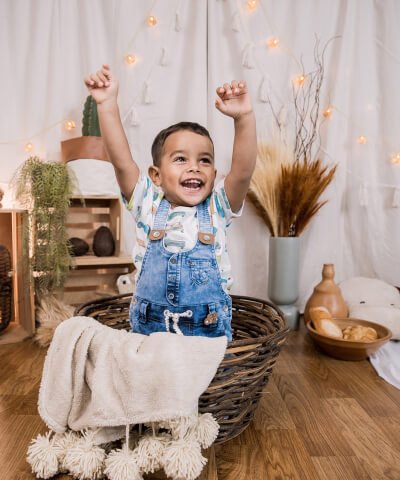
Baby gestures are the pointing, waving, reaching, and head-shaking that children use to communicate before they can say words, and they are one of the earliest signs that language is developing. A baby who points at the dog, waves goodbye, or holds up arms to be picked up is already learning how communication works.
After more than 27 years as a pediatric speech-language pathologist, one of the most common questions I hear from Vero Beach parents is, “My baby is not talking yet. Should I worry?” My first question back is almost always, “Is your child pointing and waving?”
Why do gestures come before words?
Gestures let a child share attention and ask for things before the mouth can form words. When a baby points at a ball and looks back at you, the child is saying, “Look at that,” and learning that communication goes both ways.
Research supports this link. In a 2009 study published in Science, researchers followed 50 children and found that the kinds of gestures children used at 14 months were related to their vocabulary at 54 months, although the study found a correlation rather than proof of cause. It shows why early gestures are worth noticing (Rowe and Goldin-Meadow, Science, 2009).
Which gestures should you look for, and when?
Babies develop at different speeds, so think of these as a general picture, not a deadline. In the months around the first birthday, many babies begin to wave, reach, and point. Over the second year, gestures usually grow into pointing to share interest, then pairing a point with a word.
The Centers for Disease Control and Prevention lists two milestones at 18 months that are worth knowing: the child points to show you something interesting, and tries to say three or more words besides “mama” or “dada” (CDC, Milestones at 18 Months, 2022).
| Gesture | What it tells you |
| Waving hello or goodbye | Your child is copying social routines |
| Reaching or holding up arms | Your child is asking for something |
| Pointing to request | Your child can direct your attention to what they want |
| Pointing to show | Your child wants to share an interest with you |
| Shaking or nodding head | Your child understands yes and no |
Pointing to show is especially meaningful, because it is about connection, not just getting something.
What can parents do at home to build gestures and words?
You do not need special equipment. Everyday play and routines are enough:
- Follow your child’s lead. When your child points, look where they point and name it.
- Wave and say it. Pair “bye-bye” with a wave every time someone leaves.
- Add a word to the gesture. If your baby reaches for a cup, say “cup” or “more” and then give it.
- Pause and wait. Give your child a few seconds to point, reach, or make a sound before you help.
- Play gesture games. Peekaboo, pat-a-cake, and “so big” invite imitation.
- Use simple songs with motions. Repetition helps children learn the pattern.
These small habits give your child lots of chances to communicate, and the pause is the hardest and most useful part.
When should you ask about it?
Ask your pediatrician or a speech-language pathologist if your child is not using gestures as expected, or if gestures have stopped. Reasons to ask include:
- Your child rarely points, waves, or reaches by the middle of the second year.
- Your child does not look where you point.
- Your child makes few sounds or babbles very little.
- Your child had gestures or words and then lost them.
- You have a gut feeling that something is off.
Asking is not a diagnosis. It is a way to get a clear picture and a plan, and early support is easier to start than to catch up on later. If your child has had frequent ear infections, share that too, since hearing can affect language.
What happens at a speech evaluation for a young child?
For babies and toddlers, an evaluation looks like play. I watch how your child gestures, makes eye contact, responds to their name, plays with toys, and uses sounds or words. I also ask about your child’s history and your concerns, and we talk about what to try at home. If you are curious about how a private speech practice works, you can see what to expect before you call.
Frequently asked questions
At what age should a baby start pointing? Many babies begin pointing around their first birthday, and pointing to show interest is expected by about 18 months, according to the CDC. If your child is not pointing by then, ask your pediatrician or a speech-language pathologist.
Do gestures help babies learn to talk? Yes. Gestures help children share attention and practice communication before they have words. Research has linked early gesture use with later vocabulary, although it does not prove cause.
My toddler is not waving. Is that a speech problem? Not necessarily. Waving is one of many gestures, and children vary. If your child is also not pointing, babbling, or responding to their name, an evaluation can help sort it out.
Will using gestures delay my child’s talking? No. Using gestures and words together supports language. Pair each gesture with a simple word and your child gets the best of both.
When should I have my child evaluated? Ask sooner rather than later if gestures are missing, stop, or come with few sounds or words. A short evaluation can tell you whether to watch and wait or begin support.
Questions about your child’s gestures or first words? Let’s talk.
If you are wondering whether your child’s pointing, waving, or first words are on track, a short conversation can help. Contact Vero Speech Therapy to ask questions or schedule an evaluation in Vero Beach.
About the author
Pamela Cerrato, MA, CCC-SLP, is a pediatric speech-language pathologist with more than 27 years of experience helping children and families in Vero Beach and Indian River County at Vero Speech Therapy.