The best toys for speech and language development are simple, open-ended toys that a child and adult play with together, such as blocks, pretend food, puppets, and books, because they invite talking back and forth instead of doing the talking for the child. The toy itself does not teach words. The conversation around it does.
After more than 27 years as a pediatric speech-language pathologist in Vero Beach, the question I hear every November is, “What should we buy?” Parents and grandparents want gifts that help, and the shelves are full of toys that promise to teach words, letters, and numbers. Here is what I tell families.
Do talking toys help children learn to talk?
Usually not as much as the box suggests. A study in JAMA Pediatrics followed 26 parents and infants aged 10 to 16 months as they played with electronic toys, traditional toys, and books. During play with electronic toys, parents used fewer words and had fewer back-and-forth conversational turns than with traditional toys or books, and babies vocalized less than they did with books (Sosa, JAMA Pediatrics, 2016).
It was a small study, but the finding makes sense to anyone who has watched it happen. When the toy is talking, the adult stops talking. The child listens to a recording instead of practicing with a person.
The American Academy of Pediatrics reached a similar conclusion in its clinical report on toy selection. It advises families that the most educational toy is one that encourages interaction between caregivers and children, and that electronic toys on their own do not provide the engagement that is critical to development (American Academy of Pediatrics, HealthyChildren.org, 2018).
What makes a toy good for language?
When I look at a toy, I ask three questions:
- Does it need a person to make it fun? Toys that work best with two players create reasons to talk.
- Can it be played many ways? Open-ended toys invite new words every time.
- Does it leave room for the child to lead? If the toy does all the work, the child does not have to.
A toy that passes all three is almost always a good speech and language gift.
Speech-friendly gift ideas by age
These are general ideas, not a prescription. Every child is different, so pick what fits your child’s interests.
| Age | Gift ideas | Words and skills they invite |
| Babies (6 to 12 months) | Board books, stacking cups, peekaboo cloths, balls | Sounds, early gestures, turn-taking |
| Toddlers (1 to 2 years) | Farm animals, toy cars, bubbles, shape sorters, pop-up toys | Animal sounds, “go,” “more,” “open,” “up” |
| Older toddlers (2 to 3 years) | Pretend kitchen and food, baby dolls, simple puzzles, blocks | Action words, two-word phrases, naming |
| Preschoolers (3 to 5 years) | Dress-up clothes, puppets, picture books, simple board games | Stories, questions, describing, taking turns |
Look for toys with pieces that can be named, things that open and close, and themes from your child’s everyday life, like food, animals, vehicles, and bath time. On the Treasure Coast, a beach bucket set with shovels and sea animals can be a wonderful language toy for a child who loves a day at the shore.
How should parents play to get more words?
The gift is the starting point. How you play with it matters more. A few strategies I teach families in my practice:
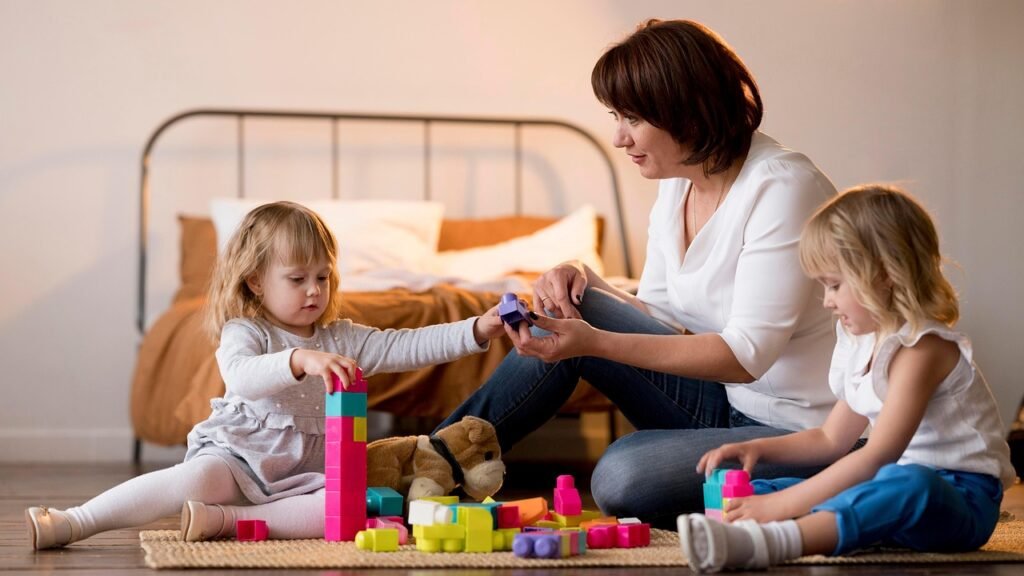
- Get face to face. Sit on the floor at your child’s level so they can see your mouth and expression.
- Follow your child’s lead. Talk about what they are already looking at or doing.
- Narrate in short phrases. “Car goes. Fast car. Car stops.”
- Pause and wait. Give your child a few seconds to fill the silence with a sound, gesture, or word.
- Add one word. If your child says “ball,” you say “big ball” or “roll ball.”
- Offer choices. “Do you want the cow or the pig?” gives a child a reason to answer.
If your child is working on specific sounds, play is a great time to practice them in a relaxed way. Pick a toy whose name has the sound, and use it many times during play. For more ideas, here are some everyday ways to help with pronunciation at home.
Are screens and apps okay as gifts?
Tablets and apps are a common holiday gift, and they are not all bad. But for young children, they rarely replace face-to-face play for language. If a screen is part of the season, watch or play together and talk about what you see, rather than handing it off.
When is a toy not enough?
A good toy supports development, but it cannot fix a speech or language delay on its own. If your child is not babbling by around 12 months, is not using single words by around 18 months, is not combining words by age 2, or is hard for family to understand by age 3, it is worth asking a speech-language pathologist for an evaluation. Trust your instincts. Asking early never hurts.
Frequently asked questions
What are the best toys for speech and language development? Simple, open-ended toys that you play with together are best, such as blocks, pretend food, toy animals, puppets, and books. They invite back-and-forth talk, which is how children learn language.
Are electronic learning toys bad for my child’s speech? They are not harmful in small amounts, but research suggests parents talk less and have fewer conversational turns with their children during electronic toy play. Traditional toys and books tend to lead to more talking.
How many toys does my child need to build language? Not many. A few toys used often, with an engaged adult, do more for language than a room full of toys. Rotating toys can keep them interesting.
What gift can grandparents give to help a child’s speech? Books and simple pretend-play sets are great choices. The best part of the gift is time spent reading and playing together during visits.
When should I see a speech therapist instead of buying more toys? If your child is missing expected milestones, such as first words by around 18 months or word combinations by age 2, or if you are worried, schedule an evaluation. Toys support development, but they do not replace therapy when a child needs it.
Questions about your child’s speech? Let’s talk.
If you are wondering whether your child’s speech and language are on track, contact Vero Speech Therapy to ask questions or schedule an evaluation in Vero Beach.
About the author
Pamela Cerrato, MA, CCC-SLP, is a pediatric speech-language pathologist with more than 27 years of experience helping children and families in Vero Beach and Indian River County at Vero Speech Therapy.