Screen time affects speech development primarily by displacing the back-and-forth conversation that young children need to learn language, and research links higher-than-recommended screen use in the earliest years to measurable delays in communication. This is one of the most common questions I hear from parents, and the honest answer is that screens are not automatically harmful, but how, when, and how much a child uses them matters a great deal.
After more than 27 years of pediatric speech therapy, I can tell you the concern is worth taking seriously without turning into panic. Children learn to talk through interaction with the people around them, and a screen, no matter how educational, cannot fully replace that.
What does the research actually say?
The evidence has grown considerably in recent years. A study published in JAMA Pediatrics found that greater screen time at age 1 was associated with developmental delays in communication and problem-solving at ages 2 and 4 (JAMA Pediatrics, 2023). The relationship was dose-dependent, meaning more screen time was linked to greater risk.
Professional guidance reflects these findings. The American Academy of Pediatrics recommends avoiding screen media other than video chatting for children younger than 18 to 24 months, and limiting screen use to about one hour per day of high-quality programming for children ages 2 to 5, ideally viewed together with a caregiver (American Academy of Pediatrics). The word together is important, because a caregiver who talks about what is on the screen turns passive watching into a language opportunity.
Why does screen time slow language learning?
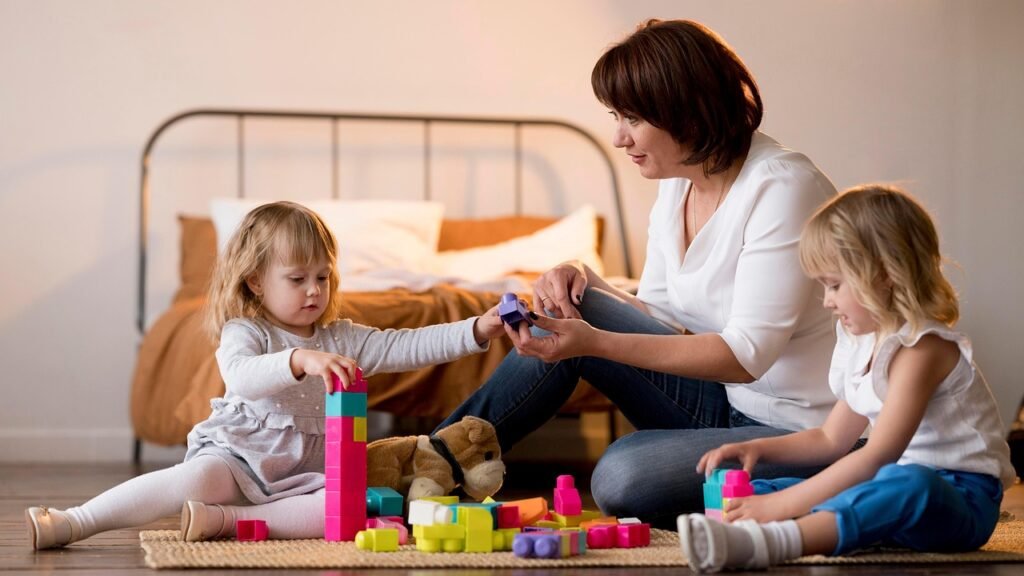
The core issue is displacement. Language develops through what researchers call serve-and-return interaction, the rapid exchange of sounds, words, gestures, and responses between a child and a caregiver. Every minute a toddler spends staring silently at a screen is a minute not spent in that exchange.
Three specific effects show up often in the children I evaluate:
- Fewer words heard. Background television and solo viewing reduce the number of live words a child hears and the number of conversational turns they take.
- Less practice talking. Screens rarely wait for a child to respond, so the child produces fewer sounds and words of their own.
- Reduced joint attention. Shared focus on a real object or activity, which is where vocabulary is built, is harder to establish when a device holds a child’s gaze.
None of this means a child who watches a show is destined for a speech delay. It means the balance of a child’s day should tip heavily toward interaction. When families swap even a portion of passive viewing for talk and play, they often see a difference, and simple ways to practice sounds at home can make that interaction easy to build into a daily routine.
How can parents use screens more wisely?
The goal is not zero screens for every family, which is unrealistic, but intentional screens. A few practical habits help protect language development:
Watch together and narrate what is happening, so the screen becomes a conversation starter rather than a conversation stopper. Choose slower-paced, high-quality content over fast, hyper-stimulating videos. Keep meals, playtime, and the hour before bed screen-free, because those are prime moments for talk. And model your own habits, since children mirror the adults around them.
Summer, when routines loosen and screens are easy to reach for, is a good time to reset these habits. Small changes add up quickly at this age.
When should you talk to a speech-language pathologist?
Screen time is one factor among many, and it is never the whole story. If your child is not meeting speech and language milestones, is not combining words by age 2, is hard to understand, or seems frustrated when trying to communicate, an evaluation is worthwhile regardless of screen habits. A licensed speech-language pathologist with the ASHA Certificate of Clinical Competence (CCC-SLP) can assess whether a true delay exists and, if so, what is driving it. Early support is far more effective than waiting to see if a child catches up.
Frequently asked questions
Is all screen time bad for my toddler’s speech? No. The concern is with excessive and passive screen use that replaces live interaction, especially in children under two. High-quality content watched together with a talking, engaged caregiver can be a shared language activity. The problem is solo, background, or fast-paced viewing that crowds out real conversation.
My child watches educational videos and knows a lot of words. Is that fine? It can be a good sign, but memorized words from videos are not the same as using language to communicate in real time. Some children recite colors or letters from a screen while struggling with everyday back-and-forth conversation. If you are unsure whether your child is truly communicating, a speech-language evaluation can clarify it.
How much screen time is recommended for young children? The American Academy of Pediatrics recommends avoiding screens other than video chat before 18 to 24 months, and limiting screen time to about one hour per day of high-quality, co-viewed content for ages 2 to 5. These are guidelines, not hard rules, and the quality of viewing and the amount of live interaction matter as much as the clock.
Can reducing screen time reverse a speech delay? Reducing passive screen time and increasing interaction often helps, but it is not a guaranteed fix for a genuine speech or language disorder. If a delay is present, targeted therapy addresses the underlying skills directly. Cutting back on screens supports that work rather than replacing it.
Does watching in another language, like Spanish, help or confuse my child? Live exposure to more than one language does not cause speech delays and can be a wonderful gift, but screens in any language still lack the interaction children need. The benefit of bilingualism comes from real conversation with real people. A screen in a second language is still a screen.
Talk to a speech-language pathologist in Vero Beach
If you have questions about your child’s speech, language, or communication, you do not have to guess. Vero Speech Therapy provides evaluations and individualized care for children throughout Vero Beach and Indian River County. To discuss your child’s needs, reach out to schedule a conversation.
About the author
Pamela Cerrato, MA, CCC-SLP, is a licensed and ASHA-certified speech-language pathologist with more than 27 years of experience in pediatric speech therapy. She founded Vero Speech Therapy to provide personalized, family-centered care to children in Vero Beach and across Indian River County, Florida.